E-Commerce Website Maintenance: The Tasks That Protect Your Revenue and Keep Customers Returning
For an e-commerce store, website maintenance is not a background task. It is an active revenue protection function. Every hour your store is offline, every minute the payment gateway fails, every product page that returns an error—these are not inconveniences. They are direct losses.
Indian e-commerce has grown significantly, and with it, customer expectations. A store that loads slowly, shows outdated stock, or fails at checkout loses not just the immediate transaction but the customer’s trust and their future orders.
This guide covers the specific maintenance requirements of Indian e-commerce websites — what needs to happen, how often, and what the consequences of neglect look like in revenue terms.
Why E-Commerce Has the Highest Maintenance Stakes
Three factors make e-commerce website maintenance more critical than for any other website type.
1. Downtime is directly quantifiable lost revenue
For a standard business website, downtime means missed enquiries. For an e-commerce store, it means missed transactions. If your store generates ₹10,000 per day and goes offline for 4 hours, that is approximately ₹1,700 in direct revenue loss from that single incident — before accounting for cart abandonments from customers who never return.
2. Payment failures destroy customer trust permanently
A customer who reaches checkout and encounters a payment error does not typically try again later. They go to a competitor. And if they experienced the error once, they are unlikely to return. Payment gateway functionality is not just a convenience feature — it is the final step in every revenue transaction on your store.
3. Security incidents have unique e-commerce consequences
E-commerce websites handle payment credentials, customer addresses, and purchase history. A security breach at an online store can result in customer data exposure, payment fraud liability, and the kind of reputational damage that is almost impossible to recover from in a market where trust drives repeat purchase behaviour.
The E-Commerce Maintenance Priority Table
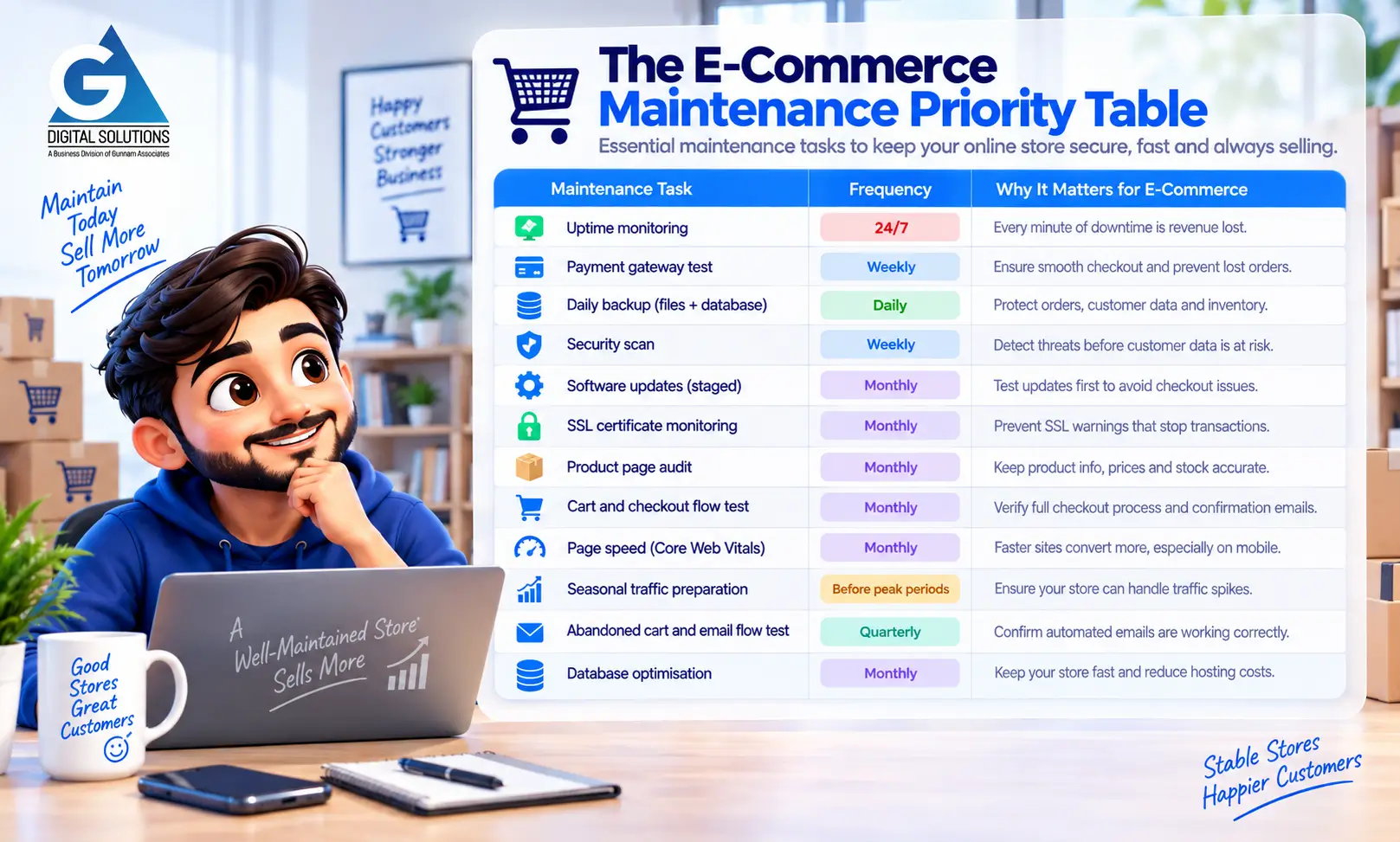
These are the maintenance tasks every Indian e-commerce website should have in place. Frequencies reflect the elevated risk profile of transactional websites.
| Maintenance Task | Frequency | Why It Matters for E-Commerce |
|---|---|---|
| Uptime monitoring | 24/7 | Every minute of downtime is revenue lost. 24/7 automated monitoring with immediate alert and 2-hour emergency response is the minimum standard for any transactional website. |
| Payment gateway test | Weekly | Test the full checkout flow end-to-end including payment completion. A gateway that fails silently at checkout means lost orders with no error visible to the store owner. |
| Daily backup (files + database) | Daily | Orders, customer records, and inventory data change daily. A weekly backup schedule is inadequate for e-commerce. Data loss between backups cannot be recovered. |
| Security scan | Weekly | E-commerce sites handling payment data are higher-value targets. Weekly scans detect injected code, compromised credentials, or suspicious activity before customer data is exposed. |
| Software updates (staged) | Monthly | Plugin and CMS updates must be tested in staging first. A WooCommerce update that conflicts with your theme can break checkout for all customers simultaneously. |
| SSL certificate monitoring | Monthly | An SSL warning on a checkout page stops all transactions instantly. Monitor expiry and initiate renewal 60 days in advance. |
| Product page audit | Monthly | Verify that in-stock products display correctly, out-of-stock products are accurately marked, prices are current, and images load properly across devices. |
| Cart and checkout flow test | Monthly | Test adding to cart, updating quantities, applying discount codes, and completing checkout with a test order. Verify order confirmation emails send correctly. |
| Page speed (Core Web Vitals) | Monthly | A 1-second delay in load time reduces e-commerce conversions by approximately 7%. Mobile speed is especially critical — the majority of Indian online shoppers browse on mobile. |
| Seasonal traffic preparation | Before peak periods | Before Diwali, Eid, sale events, or campaign launches: load test, confirm hosting can handle traffic spikes, verify all promotional code functionality, and run a full end-to-end checkout test. |
| Abandoned cart and email flow test | Quarterly | Verify automated emails — order confirmations, shipping notifications, abandoned cart recovery — are triggering and delivering correctly. |
| Database optimisation | Monthly | WooCommerce databases accumulate order data, product revisions, and session records rapidly. An unoptimised database slows the entire store and increases hosting costs. |
The E-Commerce Maintenance Mistakes That Cost Revenue

- ❌ Weekly backups instead of daily — a database failure on day 6 means losing 6 days of orders, customer records, and inventory changes that cannot be reconstructed.
- ❌ Testing checkout on desktop only — mobile checkout has distinct failure modes. A payment gateway that works on Chrome desktop may break on a mobile browser or UPI payment flow.
- ❌ Not testing after every plugin update — WooCommerce, payment gateway plugins, and shipping plugins have complex interdependencies. A single update can silently break checkout.
- ❌ Ignoring slow page speed because the store “looks fine” — customers who abandon due to slow loading generate no error message and no visible signal. The revenue loss is invisible in the store dashboard.
- ❌ No seasonal preparation — a store that crashes under Diwali traffic due to inadequate hosting or an unoptimised database loses its highest-value trading period of the year.
The most expensive maintenance gap for e-commerce stores is not a hack or a crash. It is a silent, ongoing conversion drain from slow speed, broken mobile checkout, or a payment gateway that intermittently fails. These issues accumulate quietly while the dashboard shows orders — just fewer than there should be.
What an E-Commerce Maintenance Plan Should Include
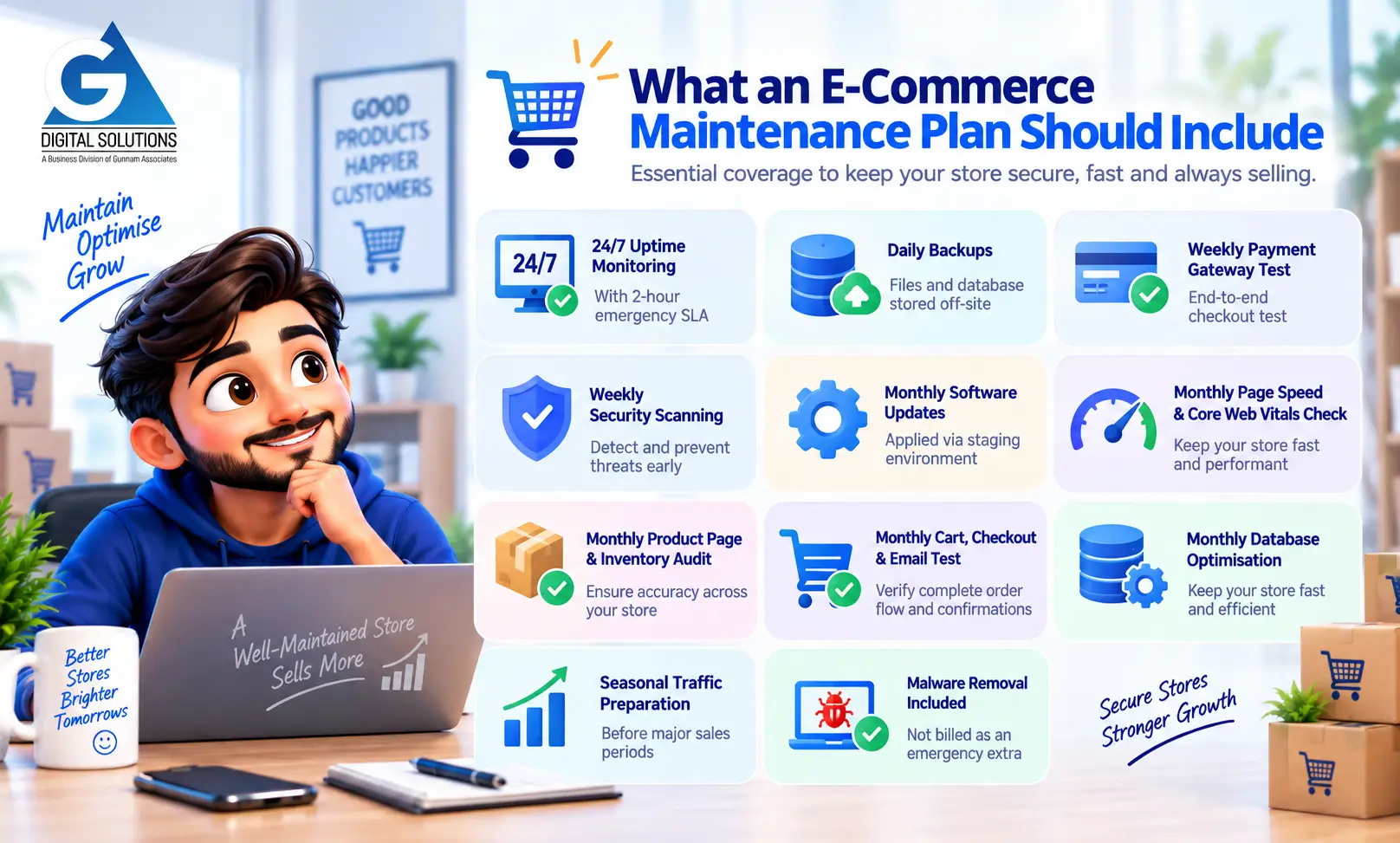
At minimum, a professional maintenance plan for an Indian e-commerce store should cover:
- ✅ 24/7 uptime monitoring with 2-hour emergency SLA
- ✅ Daily automated backups — files and database — stored off-site
- ✅ Weekly payment gateway end-to-end checkout test
- ✅ Weekly security scanning
- ✅ Monthly software updates applied via staging environment
- ✅ Monthly page speed and Core Web Vitals check
- ✅ Monthly product page and inventory accuracy audit
- ✅ Monthly cart, checkout, and order confirmation email test
- ✅ Monthly database optimisation
- ✅ Seasonal traffic preparation before major sales periods
- ✅ Malware removal included — not billed as an emergency extra
We maintain WooCommerce, Shopify, and custom e-commerce websites for Indian businesses. Our free audit covers all the priorities above. No cost, no obligation.
Summary
E-commerce website maintenance is revenue protection. Every task in this guide — from daily backups to weekly checkout testing to seasonal preparation — exists to prevent a specific, quantifiable category of revenue loss.
The standard is higher for e-commerce than for any other website type: daily backups, 24/7 monitoring, weekly payment testing, staged updates, and a fast emergency response SLA. These are not luxuries — they are the basic operational requirements of a transactional website.
GA Digital Solutions maintains e-commerce websites for Indian businesses across WooCommerce, Shopify, and custom platforms. Our free 20-point e-commerce audit is the right starting point for any store owner who wants to know where the gaps are.
Comments
Post a Comment